Jackpoty Registration and KYC Verification
 Available in GB
Creating a Jackpoty account begins with eligibility, not with filling in a form. Jackpoty’s current terms, last updated 18 February 2026, list the United Kingdom among restricted countries for real-money play. For that reason, this guide does not provide UK sign-up instructions or any method for bypassing country, identity or geolocation controls. It explains the account and KYC requirements that the operator publishes generally: users must provide accurate personal details, meet the applicable age requirement, and may need to submit government-issued photo ID, proof of address and additional verification material before an account is fully verified or a withdrawal is released.
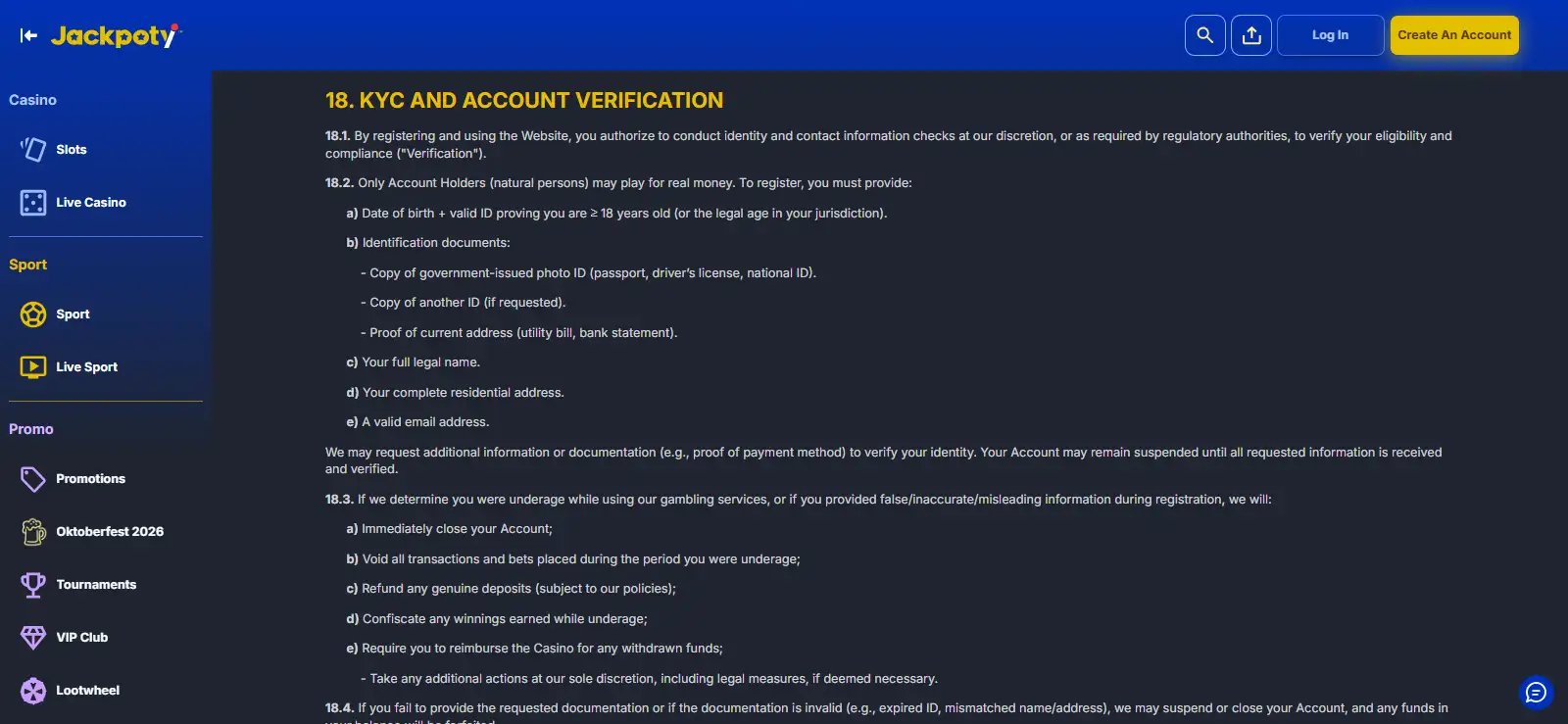
Table of Contents
- Step zero: confirm whether registration is permitted
- What information the current terms require
- Verified document categories
- How to prepare documents without creating avoidable mismatches
- Standard KYC versus additional verification
- Verification can affect account access and withdrawals
- Age verification and account ownership
- Source-of-funds and payment checks
- What this page does not promise
- Registration, bonuses and verification are separate questions
- A verification-first account checklist
- What happens when submitted details do not match
- Why the account lifecycle matters more than the sign-up screen
- Practical takeaway
Step zero: confirm whether registration is permitted
For a geo-targeted account guide, eligibility has to come before mechanics. Jackpoty’s current terms say real-money use is prohibited for users from a list of restricted countries and regions, and that list includes the United Kingdom. The same section says users are responsible for determining whether use of the service is lawful in their jurisdiction and prohibits attempts to bypass geographic restrictions with a VPN.
That means a UK-facing editorial page should not turn a generic registration form into a how-to guide. A visible sign-up button or a technically reachable page is not stronger evidence than current account terms. The useful information is instead what the operator asks from an eligible account holder and how verification affects the account lifecycle.
For the broader regulatory and licence context, see the licence and restrictions guide. It separates the operator’s stated licence from UKGC status and avoids treating technical accessibility as proof of UK market eligibility.
What information the current terms require
Jackpoty’s KYC section states that registration and use authorise identity and contact-information checks. It says only natural persons may hold real-money accounts and lists core personal information including date of birth, full legal name, complete residential address and a valid email address. The terms also require proof that the user meets the minimum age requirement, which is at least 18 or the higher legal gambling age that applies in the user’s jurisdiction.
Those fields are not merely profile preferences. They form the data set against which later identity and payment checks can be compared. Inaccurate or mismatched details can therefore create problems well after registration, particularly when funds are being withdrawn. A practical account review should treat data accuracy as part of KYC readiness, not as a cosmetic setup issue.
Verified document categories
The current official terms list a copy of a government-issued photo ID such as a passport, driving licence or national ID, plus proof of current address such as a utility bill or bank statement. They also say an additional ID can be requested and that further information or documentation, including proof of payment method, may be required to verify identity.
Another section of the terms gives similar examples for anti-fraud verification: government-issued photo ID, proof of address and proof of payment method such as a card image or an e-wallet account record. The important finding is that the document categories are published, but the exact package can depend on the account and the request. It would be misleading to convert the examples into a claim that every user always submits the same three files.
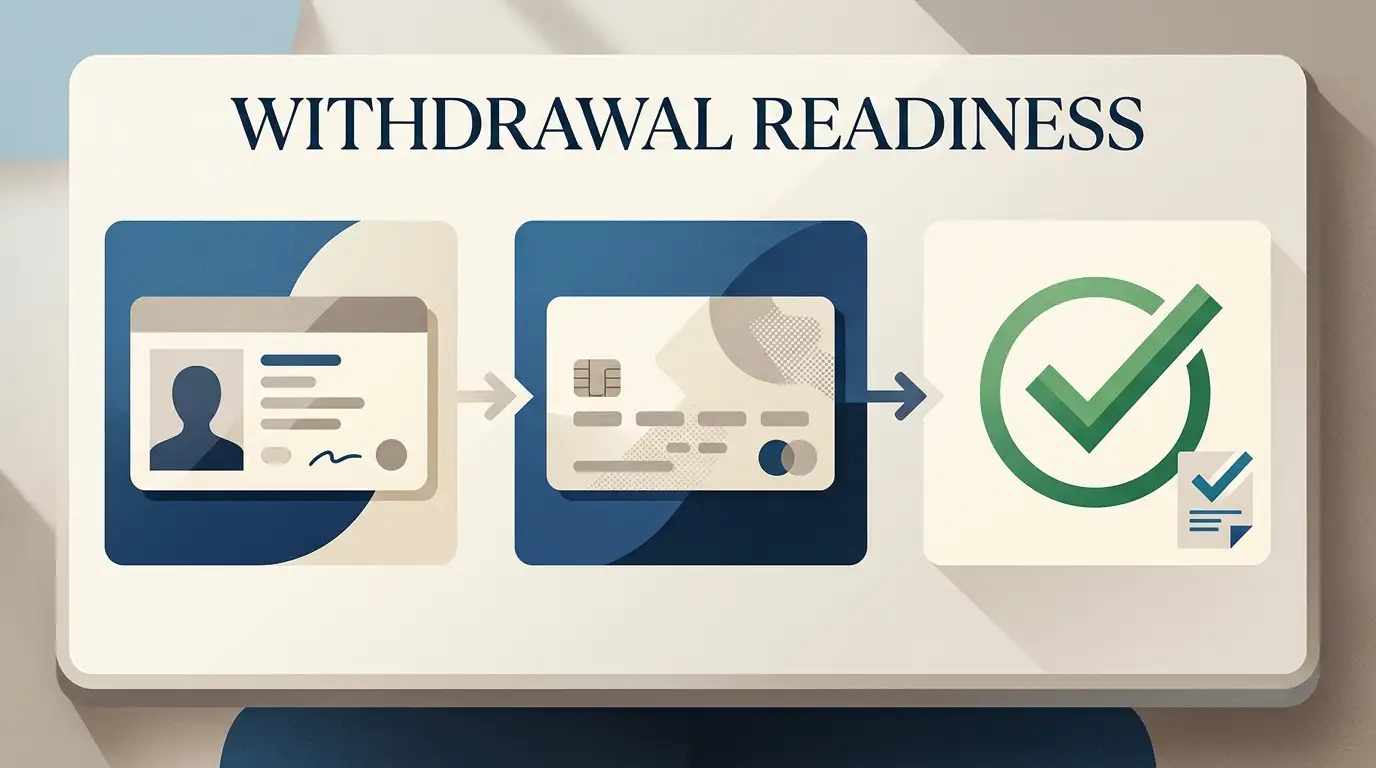
These requirements connect directly to the withdrawal verification process, because the terms say payout requests can remain pending until required verification is complete.
How to prepare documents without creating avoidable mismatches
A useful verification checklist is mostly about consistency and legibility. The name on identity evidence should match the account name. Address evidence should show the current residential address used for the account. An identity document should be valid rather than expired, and uploaded images should show the information needed for verification without being cropped so tightly that document context disappears.
If proof of a payment method is requested, follow the operator’s current instructions and expose only the information that the verification process specifically requires. Do not send unnecessary sensitive data through unofficial channels. The terms provide examples of payment-method proof, but a user should rely on the live verification request for the exact format and redaction requirements.
These are document-quality principles rather than shortcuts. They do not remove the operator’s right to ask for another document, a contact check or a different format where the existing material does not establish identity sufficiently.
Standard KYC versus additional verification
Standard KYC is the core identity-and-address process. Additional verification is what can happen when the operator needs more assurance about the person, payment method or account activity. Jackpoty’s current terms reserve the right to request extra information, conduct a phone call and, in some circumstances, use video verification.
The presence of those options does not mean every account will receive the most intensive review. It means the operator’s published process is risk-based enough to extend beyond the basic ID-and-address package. A clear review should therefore distinguish “documents the terms list” from “documents every player definitely submits” and should not invent a universal processing sequence.
Verification can affect account access and withdrawals
Jackpoty’s terms say an account may remain suspended until requested information has been received and verified. They also state that withdrawal requests remain pending until required verification steps are completed. This is the operational link between account KYC and payout processing.
That link is why delaying verification until the first withdrawal can create friction. For an eligible user, the sensible account-management approach is to respond to legitimate verification requests when they arise and keep account details consistent with the supporting documents. But this page does not advise a UK user to open an account, because the current terms list the United Kingdom as restricted for real-money play.
The payment methods covers the verified global payment list and explains why a global method list should not be treated as evidence of UK cashier availability.
Age verification and account ownership
The terms require users to meet the minimum gambling age and permit proof-of-age checks. They also state that each individual may maintain only one personal player account and prohibit account sharing. These rules matter for KYC because identity evidence is supposed to connect one natural person to one account, not validate a shared household login or a borrowed profile.
Duplicate-account rules can also intersect with addresses, IPs and devices. That does not mean every shared household is automatically fraudulent, but it does mean the published terms treat duplicate-account indicators seriously. Users should not create additional accounts in an attempt to solve a verification problem or access another promotion.
Source-of-funds and payment checks
The general casino terms focus on identity, address and payment-method evidence. The wider Jackpoty terms set also gives the operator scope to conduct anti-fraud checks and request additional information where needed. A payment-method check can therefore be different from basic identity verification: it is intended to establish that the funding route belongs to or is legitimately controlled by the account holder.
This distinction is useful when reading support requests. “Please verify your identity” and “please prove this payment method” are not necessarily duplicate requests. They answer different questions. A good account guide should make that difference visible rather than describing every document request simply as KYC.
What this page does not promise
It does not promise an exact KYC completion time. The current casino terms describe the required steps and the consequences of incomplete verification, but a universal account-verification turnaround should not be inferred from a different product section or an old third-party review. Processing can depend on what is requested and whether submitted material resolves the check.
It also does not state that successful KYC overrides geographic restrictions. Identity verification answers who the account holder is; it does not transform a restricted jurisdiction into an eligible one. Likewise, seeing GBP elsewhere on a site, reaching a registration page or finding a global payment method does not by itself prove that UK real-money registration is currently accepted.
Registration, bonuses and verification are separate questions
A bonus can have its own eligibility and wagering rules, but those rules should not be confused with account eligibility or KYC. Even where a promotion is visible, the relevant questions remain separate: can the person lawfully and contractually use the service, can the account be verified, and does the promotion apply to that account?
For offer mechanics, use the bonus guide. This account page deliberately avoids presenting a promotion as proof that a UK user can register, deposit or claim it.
A verification-first account checklist
- Check territory eligibility. Read the current restricted-country wording before attempting registration.
- Use accurate personal data. Name, date of birth, residential address and email should reflect the account holder’s real details.
- Prepare valid ID. Current terms list government-issued photo ID as a core document category.
- Prepare current address evidence. Utility bills and bank statements are examples in the terms.
- Expect possible additional requests. Extra ID, payment-method evidence, phone contact or video verification can be requested.
- Do not create duplicate accounts. The terms restrict users to one personal account.
- Do not use a VPN to bypass restrictions. The terms explicitly prohibit that behaviour.
What happens when submitted details do not match
The current terms explicitly allow account suspension or closure when requested documentation is not supplied or when information is invalid, expired or inconsistent. That creates a practical reason to review account data before sending documents. A spelling variation, old residential address or expired identity document can turn what should be a straightforward check into a manual review. The safest approach is not to edit documents or improvise explanations, but to correct account details through the operator’s legitimate process and provide current evidence that matches them.
Payment evidence has the same consistency requirement. If a method belongs to another person, or the visible account-holder details do not align, the operator can ask for clarification or additional proof. This is one reason account sharing and borrowed payment methods create avoidable verification problems.
Why the account lifecycle matters more than the sign-up screen
A registration form shows only the first moment of an account. The full lifecycle includes eligibility, age checks, identity verification, payment verification, ongoing anti-fraud review and withdrawal checks. Looking only at how quickly the form can be completed therefore gives a weak picture of the real account experience. For a decision-focused review, the more useful questions are whether the operator clearly identifies required data, which evidence categories can be requested, what happens while verification is incomplete and how those checks connect to payouts.
This lifecycle view also prevents a common mistake: treating successful form submission as proof that every later action is permitted. Geographic restrictions, payment availability and bonus eligibility are separate controls and can be evaluated at different stages.
Practical takeaway
Jackpoty’s published KYC framework is clear on the core categories: identity, age, address and potentially payment-method verification. Those checks can affect account access and withdrawals, and the operator can request additional information where the first submission does not complete the review.
For a UK reader, however, the eligibility check comes first. The current official terms list the United Kingdom among restricted countries for real-money play, so this guide intentionally stops short of sign-up instructions. For a wider view of the brand, return to the full review; for payout-specific verification, use the withdrawals page.
Prepared by the Jackpoty Casino editorial staff.