Jackpoty Licence, UKGC Status and Trust Checks
 Available in GB
Jackpoty’s current terms identify Novatrix SRL as the operator and state that the casino operates under Tobique Gaming Commission licence no. 0000002. That is a non-UK licence. A check of the UK Gambling Commission public business register on 26 September 2026 did not verify a UKGC operating licence for Jackpoty, jackpoty.com or Novatrix SRL. For readers in England, Scotland and Wales, that distinction matters because the UKGC says businesses providing remote gambling to consumers in Great Britain need the relevant Gambling Commission licence. Northern Ireland has a different legal framework, and the UKGC states that it does not regulate the provision of remote gambling there, although a UKGC licence is required to advertise remote gambling to Northern Ireland consumers. This page separates those facts rather than turning them into a blanket “legal” or “illegal” label for the whole United Kingdom.
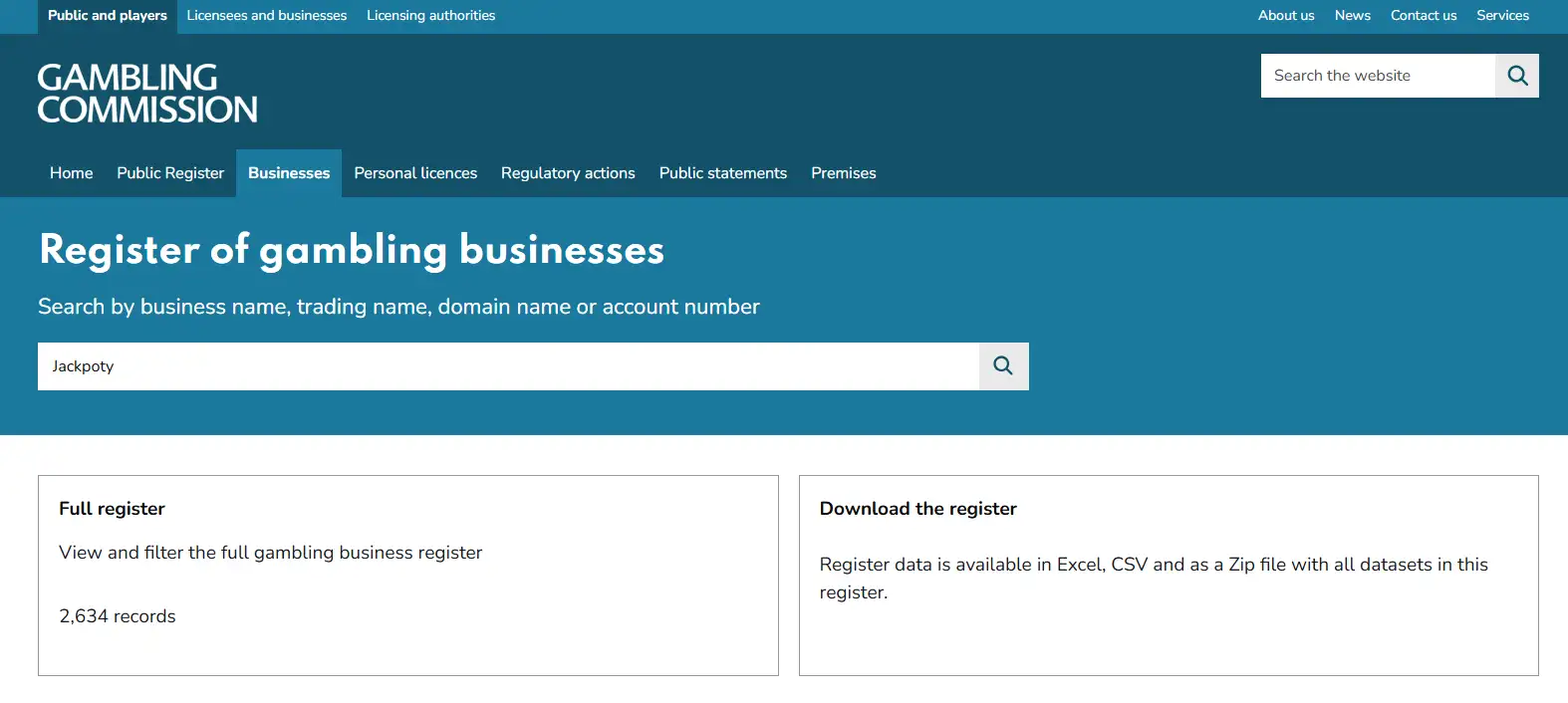
Table of Contents
- What licence does Jackpoty state it holds?
- UKGC register result: no local licence verified
- Why UKGC status matters in Great Britain
- Great Britain and Northern Ireland are not the same regulatory question
- The current Jackpoty terms create a separate availability conflict
- What a UKGC licence would normally tell a British consumer
- Current Great Britain safer-gambling benchmarks
- What about financial-risk assessments?
- Are gambling winnings taxed for UK customers?
- A practical five-minute trust check
- What the absence of a verified UKGC entry does and does not prove
- Why the date of a register check matters
- How this connects to withdrawals and KYC
- Practical takeaway
What licence does Jackpoty state it holds?
The official Jackpoty terms, last updated 18 February 2026, identify the website owner and operator as Novatrix SRL, registered in Costa Rica, and state that the company operates under e-gaming licence no. 0000002 issued by the Tobique Gaming Commission. The same operator-and-licence wording is repeated in the Jackpoty site footer and sportsbook terms. That makes the operator identity and stated Tobique licence current first-party facts rather than a licence claim copied from an affiliate review.
The important qualification is jurisdiction. A Tobique Gaming Commission licence is not a UK Gambling Commission licence and should not be presented as one. Different regulators set different licence conditions, complaint routes, technical standards and enforcement processes. For a UK-facing trust check, the useful question is therefore not simply “is there a licence?” but “which regulator issued it, and does that regulator cover the consumer and activity being discussed?”
UKGC register result: no local licence verified
The UK Gambling Commission maintains a public business register that can be searched by business name, trading name, domain name or account number. The register states that its business data was last updated on 26 September 2026. A search for Jackpoty, jackpoty.com and Novatrix SRL did not produce a verified Jackpoty UKGC operating-licence entry. The resulting finding is therefore: no UK Gambling Commission licence was verified for Jackpoty in the public register.
That wording is intentionally narrower than saying a licence “does not exist” in every conceivable form. Public-register checks are evidence-led snapshots, and names can change. The reproducible method is what matters: open the UKGC public business register, search the brand, domain and operator name separately, inspect any matching account, then verify whether the domain or trading name is active under an appropriate remote operating licence.
A review page should not substitute a logo, certificate image or third-party badge for that register check. It should also avoid implying that offshore licensing and UKGC licensing are equivalent. The two facts can coexist: Jackpoty states a Tobique licence, while no Jackpoty UKGC licence was verified.
Why UKGC status matters in Great Britain
The UKGC’s remote-casino licensing guidance says that, regardless of where a business is based, it needs a Gambling Commission licence if it provides gambling facilities online to consumers in Great Britain. Great Britain here means England, Scotland and Wales. The Commission’s remote-sector guidance makes the same point and gives the example of an overseas business that still needs a UKGC licence when serving British consumers.
This is a regulator-scope rule, not a review-site opinion. It explains why a UK reader should check for the local licence rather than treating any overseas licence as interchangeable. A UKGC-licensed operator is subject to the Commission’s Licence Conditions and Codes of Practice, remote technical standards and enforcement framework for its British activity. Without a verified UKGC licence, this guide does not claim that those UKGC protections or dispute routes apply to Jackpoty.
The broader KYC guide covers account-verification mechanics, but licence scope should be checked before treating a reachable registration page as proof that a British consumer is eligible to play.
Great Britain and Northern Ireland are not the same regulatory question
“UK licence” is convenient shorthand, but it can blur an important geographic distinction. The UKGC says it regulates gambling businesses operating in Great Britain and explicitly states that it does not regulate the provision of remote gambling in Northern Ireland. Northern Ireland continues to have its own gambling-law framework under the Betting, Gaming, Lotteries and Amusements (Northern Ireland) Order 1985 as amended in 2022.
At the same time, the UKGC says it is an offence to advertise remote gambling to consumers in Northern Ireland unless the business holds a Gambling Commission licence. That creates a mixed picture: the Commission’s direct regulation of remote gambling provision is a Great Britain issue, while UKGC licensing still matters to remote-gambling advertising into Northern Ireland.
For that reason, a single statement such as “licensed for the UK” or “unlicensed in the UK” can hide more than it clarifies. A careful review should state the exact territory and regulatory function being discussed.
The current Jackpoty terms create a separate availability conflict
Current Jackpoty terms list the United Kingdom among territories restricted from real-money play. That is separate from the UKGC register result. One fact concerns the operator’s own account restrictions; the other concerns local regulatory licensing. They should not be collapsed into a single inference.
Practically, this means a UK-facing review should not use a visible bonus, payment method, mobile page or technically accessible registration screen as proof that a UK resident can open and use a real-money account. It also means this trust page does not provide a workaround for location controls. Jackpoty’s terms prohibit VPN use to bypass geographic restrictions.
If you are comparing offer mechanics rather than account eligibility, use the bonus terms guide. Bonus visibility and country eligibility are different questions.
What a UKGC licence would normally tell a British consumer
For a business that is actually licensed by the UKGC for remote gambling in Great Britain, the register gives an account name, licence status, declared trading names and domains, and the activities covered. It is a useful first-line identity check because a consumer can compare the website domain with the domain declared under the licensed business.
UKGC licensing also brings a set of British regulatory benchmarks. The Commission’s framework covers customer interaction, safer-gambling tools, game rules and technical standards. Those standards are relevant context for comparing offshore sites, but they should not be described as direct Jackpoty obligations unless a Jackpoty UKGC licence is verified.
Current Great Britain safer-gambling benchmarks
Several UKGC rules give readers concrete benchmarks for what licensed British remote gambling looks like. Online slot stake limits are £5 per game cycle for customers aged 25 and over and £2 for customers aged 18 to 24. These are Great Britain regulatory limits for licensed online slots, not claims about the settings on Jackpoty.
The Commission also requires licensed remote operators to run customer-interaction systems that identify gambling-harm risk, take appropriate action and evaluate the effect of that action. The purpose is to make harm monitoring an operational process rather than a passive responsible-gambling footer.
Deposit-limit requirements have also changed. The UKGC extended the implementation date, and the current regulator position is that from 30 September 2026 licensed online operators must offer gross deposit limits and only this gross measure may be called a “deposit limit”. As of 26 September 2026, that rule is four days from its effective date rather than already in force.
These benchmarks are useful when evaluating protection standards, but they must remain clearly attributed to licensed Great Britain operators. They are not evidence that Jackpoty is supervised by the UKGC.
What about financial-risk assessments?
In July 2026 the UKGC described a staged plan for financial risk assessments for high-spending customers at licensed British operators. The Commission said the vast majority of customers would not require an assessment and that most assessments would be frictionless. Implementation is staged rather than a simple universal check on every account.
This is another example of why licence scope matters. Regulatory developments can be useful context for British consumers, but they should not be copied into a Jackpoty review as if Jackpoty itself is necessarily applying the UKGC process. The correct comparison is between the published British licensed-market framework and the evidence available for the brand being reviewed.
Are gambling winnings taxed for UK customers?
The UK Gambling Commission confirmed in a May 2026 Freedom of Information response that gambling winnings for customers in the UK are tax-free regardless of the amount won, with gambling duties instead levied on operators. HMRC’s published duty guidance likewise deals with taxes on gambling businesses and gaming profits rather than a general tax charge on ordinary customer winnings.
That is a general UK tax-context fact, not a statement that every payment from every gambling website is automatically outside every possible tax issue. Personal circumstances can be more complex when gambling activity forms part of another business or legal arrangement. For the ordinary customer-winnings question addressed here, the regulator’s current answer is that the winnings themselves are tax-free.
A practical five-minute trust check
- Identify the legal operator. Read the current terms and footer, not only the home-page brand name. Jackpoty currently identifies Novatrix SRL.
- Record the stated licence jurisdiction. Jackpoty currently states Tobique Gaming Commission licence no. 0000002.
- Search the local regulator. For Great Britain, search the UKGC register by brand, domain and operator name.
- Match the exact domain. A similarly named licence holder is not enough; check whether the domain you are using is declared under the licence.
- Check account restrictions separately. Operator terms can restrict territories even where a website is technically reachable.
This process gives more decision value than a generic “trusted” badge because each step can be reproduced from a primary source.
What the absence of a verified UKGC entry does and does not prove
It supports a precise finding: this review did not verify a Jackpoty UKGC operating licence in the current public register. It also means this page will not claim UKGC consumer-protection coverage, UKGC alternative-dispute-resolution coverage or direct application of UKGC remote-operator requirements to Jackpoty.
It does not, by itself, settle every legal question across the whole United Kingdom. Great Britain and Northern Ireland differ, operator terms create their own contractual restrictions, and legal judgments can depend on the exact activity being considered. That is why this page reports the underlying evidence and regulator scope rather than issuing a one-word label.
Why the date of a register check matters
Licence evidence is time-sensitive. The UKGC register records active, suspended, surrendered, revoked and other licence states, and the register itself is updated over time. An older saved register view or review can therefore be less useful than a fresh search. This guide records the check date so a reader can repeat it and see whether the result has changed. If a later register search produces a matching Jackpoty or Novatrix entry, the newer primary record should take priority over this page.
How this connects to withdrawals and KYC
Licence status and payout mechanics should also stay separate. Jackpoty’s current terms contain identity and withdrawal-verification rules, but those rules do not create a UKGC licence. If your question is about documentation, pending payouts or payment-method checks, see the withdrawal checks guide. It focuses on the operator’s current published process rather than treating regulatory status as a substitute for payment evidence.
Practical takeaway
Jackpoty’s current first-party material identifies Novatrix SRL and states a Tobique Gaming Commission licence. A current UKGC public-register check did not verify a Jackpoty UKGC licence. For Great Britain, the UKGC says remote operators serving consumers there need the relevant Commission licence; Northern Ireland has a separate gambling-law framework and a different relationship with the UKGC.
That combination is enough to make regulator scope a central trust check. It is not a reason to invent a broader legal claim. Return to the full review for the brand-level overview, and use primary regulator records whenever licence status is material to your decision.
Published by the Jackpoty Casino team.